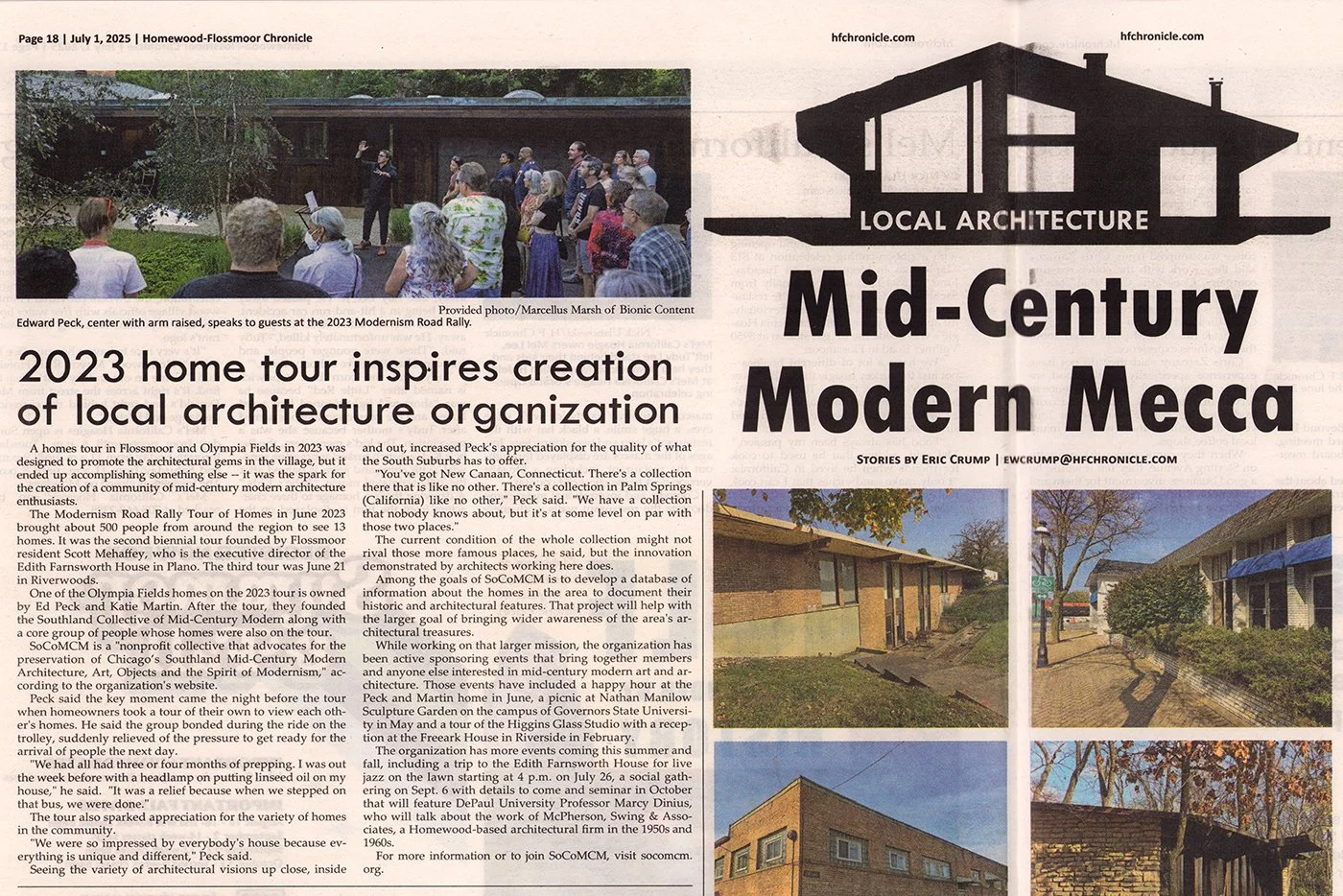
SoCoMCM is a volunteer research group recording, preserving, and celebrating Mid-Century Modern architecture across Chicago's south suburban communities — from Flossmoor to Blue Island, Olympia Fields to Homewood.
The MISSION of SoCoMCM is to bring awareness to the exemplary enclave of mid-century modern architecture in Chicago's Southland while also providing a forum for modernist enthusiasts and homeowners to gather, collaborate, and work towards preservation.
SoCoMCM advocates for safeguarding mid-century modern structures, artwork, objects, and the modernist ethos. We catalyze preservation initiatives and revitalize architectural interest across Southland communities through education, documentation, outreach, and advocacy. Programming encompasses architectural tours, educational lectures, and workshops addressing renovation tactics, design history, landscape planning, and landmark designation.
Founded in 2024 by Edward Peck, FAIA, the organization launched with member-supported programming and has grown into an active community of researchers, homeowners, architects, and preservationists dedicated to the Southland's extraordinary built heritage.
A design movement that emerged after World War II and flourished from roughly 1945 to 1975. It brought open floor plans, large glass walls, and a belief that good design could improve everyday life to the American suburb.
Horizontal profiles that hug the landscape, often with deep overhangs designed to shade interior glass from summer sun while admitting winter light — a passive solar principle pioneered locally by Keck & Keck.
Walls of windows dissolved the boundary between interior and exterior, flooding homes with natural light and framing views of gardens and landscape — a radical departure from the small windows of earlier styles.
The postwar American family embraced informal living. MCM homes replaced rigid room divisions with flowing spaces where kitchen, dining, and living areas merged into a single, social environment.
Organic materials — stone, wood, brick — anchored homes to their sites. Courtyards, atriums, and planted terraces brought the outdoors in. Many homes were oriented to maximize a specific garden view.
Boomerang countertops, starburst clocks, terrazzo floors. The postwar optimism about science and the future expressed itself in playful, forward-looking ornamentation that remains immediately recognizable today.
MCM architects believed that honest expression of structure and materials was itself beautiful. Exposed beams, visible brick, and concrete without cladding were features, not oversights.
Keck & Keck exhibit a 12-sided glass house at Chicago's Century of Progress Exposition. The public is transfixed.
Veterans return home. Suburbs expand rapidly. Architects bring modernism to the mass residential market.
Flossmoor, Olympia Fields, and Homewood see waves of MCM construction. Major architects are active in every community.
Postmodern and colonial revival tastes begin to displace modernism. MCM construction slows but never fully stops.
A new generation rediscovers MCM. SoCoMCM documents what remains before renovation, neglect, or demolition claims it.
A selection of documented homes, schools, and public buildings from the survey. Each entry represents primary-source research.
House tours, research meetings, photography walks, and public lectures — all free or low-cost and open to members.
Brothers George Frederick and William Keck changed what the American house could be. Their 1933 "House of Tomorrow" — a 12-sided glass-and-steel dodecagon at the Century of Progress Exposition — introduced the country to modernist domestic design. They followed it with the "Crystal House" the next year, and spent the next five decades designing solar-conscious residences across the Chicago region. The south suburbs hold the highest concentration of their residential work anywhere, with clusters in Flossmoor and Olympia Fields. Every Keck home features their signature solar overhang: precisely calculated to block midsummer sun while admitting low winter light. It was passive solar design sixty years before the term existed.
View All Keck & Keck Properties →
MCM architecture flourished across the entire Chicago south suburban region — not just in wealthy enclaves, but in working-class communities, industrial towns, and planned developments alike.
From Blue Island to Crete, from Markham to Munster (Indiana), the survey has found documented MCM buildings in every corner of the south metropolitan area. Some communities — Flossmoor, Olympia Fields, Homewood — have dense concentrations. Others contain isolated gems: a single school, one church, a lone architect-designed house on an otherwise ordinary block.
Each community on this list has at least one documented property in the database. Click any community chip to browse its properties.
SoCoMCM is a volunteer group open to anyone interested in architectural history, photography, genealogical research, or simply the love of great mid-century design. No expertise required — only curiosity.